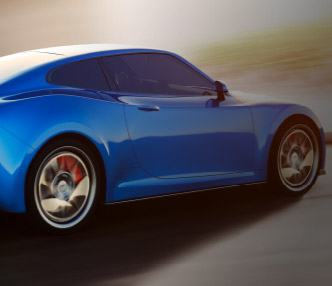
The layer based construction techniques of plastic AM offers significant benefits in terms of build speed, however it can sometimes give a stepped surface finish. From a purely functional aspect this is seldom a problem, however from the aesthetic perspective they may require additional finishing.
Our skilled team of finishers combine the functionality of plastic AM parts with high quality aesthetics, with minimal time added to the delivery. Providing a range of finishing techniques from simply adding a colour or highlighting certain areas, to fully finished marketing models, a finished prototype can play a vital role in functionality testing, securing tender bids, design verification and marketing photography.

Our modelmakers ensure every last detail is taken care of and our bespoke finishing services enable the inclusion of mechanical components, inserts or screw threads, generating a model that is comparable to the final manufactured item.
Finishing Grades
Varying finishes can be achieved and we offer 5 standard grades, from a light blasting over or a dusting of paint on identified surfaces, to the majority of the layering removed from the external surfaces and paint or a permanent surface colouring applied.
| Grade 5 | Parts direct from the machine and blasted. |
| Grade 4 | Vibro finished either on a 2 or 4 hour cycle, smoothing the surface. Suitability for this process is dependent upon geometry of the parts and layering may still remain. |
| Grade 3 | Parts are painted on identified surfaces or they are given a permanent surface colouring (see below). Both these processes can be applied directly to a Grade 4 or 5 finish. If applied to a Grade 5 finish this will leave the original surface finish but just change the colour of the part. If permanent colour is applied to a Grade 4 finish the depth of the colour may not be as deep as when applied to a Grade 5 part. |
| Grade 2 | Parts have the majority of the layering removed from the external surface, dependent on geometry. They are then painted with either a primer or top coat paint. |
| Grade 1 | As per Grade 2 but with the addition of texture to the painted surface. |
As the level of finishing is directly related to component cost it is important not to over specify the requirement. Frequently the optimum is to select different parts to different grades of finish. For example, a batch of 50 parts could be split into 2 for assembly and aesthetic review (Grade 1), 5 for general assembly and review (Grade 2 or 3) and 43 for trials (Grade 4 or 5). This approach minimises cost and maximises speed of response.
Other specific options are available, including a fully finished marketing model or assembly with inserts and mechanical components. Please Contact Us to discuss your project in more detail, and we will be pleased to provide you with a quotation for your specific finishing requirements.
Permanent Surface Colouring
We have pioneered a low cost method of improving the visual impact of our prototype components with a revolutionary colouring process. Requiring no surface dressing, functionality and lead time remain unaffected. This post-process is usually covered by a flat charge irrespective of parts count.
With plastic AM components finding themselves in a vast range of applications, they can be transformed by the application of a single colour. Assemblies become clearer and resilience to handling discolouration is enhanced, giving a far better communication of design intent.
Single parts or large batches can be supplied in a range of standard colours, including RED, BLUE, GREEN, ORANGE, PURPLE, YELLOW and, most popular, BLACK. Additional colours may be available – please Contact Us if you have specific colouring requirements.
NB. Unless otherwise stated on our quotation, a permanent surface colouring is applied directly to a Grade 5 finish, ie. the part is coloured, but ‘undressed’.
Inserts
We can fit inserts into your part which will gave a robust thread for prototyping or manufacturing applications. We use Tappex Multisert Unheaded Short inserts. Please visit the Tappex insert guide for designing the receiving hole.
The inserts are fitted by heat staking them into the receiving hole and minimum wall thicknesses should be exceeded where possible, to strengthen the insert fitment.
Other size inserts are available on request.